I learned something most interesting today. There is bergamot and then there is bergamot. One is a citrus fruit and the other is an herb in the mint family.
Being a long-time fan of Earl Grey tea, I was familiar with Bergamot oranges.
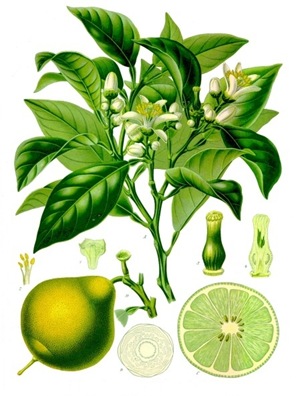
image from Wikipedia
The Bergamot orange is believed to be a cross between the Seville orange and the pear lemon. The resulting fruit is green when young, maturing to a yellowish orange with a distinct nipple at one end. It is rather small and very sour--inedible really. It is the essential oils in the rind of this citrus fruit that are used to flavor Earl Grey tea. My favorite Earl Grey is "Double Bergamot Earl Grey" from the Stash Tea Company of Tigard, Oregon. Today 93% of the bergamot orchards are to be found in Calabria, Italy and the Ivory Coast.
In France essence of bergamot is much used in candy making. In the city of Nancy there is a specialty known as Bergamote de Nancy. So special are these unique golden candies that they have been granted an I.G.P. by the European Union. I.G.P. stands for Indication Géographique Protégée or Protected Geographical Indication (P.G.I.) in English. For a photo of the Bergamot orange check out Chocolate & Zucchini. If your French isn't too rusty check out Cuisine Campagne for a crêpe recipe or one for Petit gâteaux moelleux à la bergamote et à l'huile d'olive. For the more scientifically inclined, here is a most interesting article from Culture, Science, Chimie. And for the economically inclined, this 2006 article from the BBC about the bergamot growers in Calabria.
Now for the other bergamot, Monarda.

Image from Wikipedia
From the mint family and a native of North America, Monarda has many names.
- Monarda didyma: Oswego Tea, Scarlet Monarda, Bee Balm, Blue Balm, High Balm, Low Balm, Mountain Balm, Mountain Mint, Bergamot
- Monarda fistulosa: Bee Balm, Bergamot, Horsemint, American Horsemint, Long-flowered Horsemint, Purple Bergamot, Oregano, Plains Bee Balm, Fern Mint
- Monarda punctata: Horsemint, Spotted Monarda, Monarda Lutea, Wild Bergamot
And while we're on the topic of names, the genus "Monarda" was named for Nicolás Bautista Monardes (1493-1588), a botanist and physician from Seville, Spain. Even though he never traveled to North America, Monardes studied many of the plants from the "New World" right in his garden in Seville. He had easy access to these plants as Seville controlled navigation and commerce in the 16th century. Monardes' major work was his herbal, Historia medicinal de las cosas que se traen de nuestras Indias Occidentales, published in three parts between 1565 and 1574.
In North America Monarda has a long history of medicinal use among the Ojibwe, Lakota, Chippewa, Crow, Winnebago, Blackfeet, Menominee and Navajo. Its properties include antiseptic, anti-inflammatory, antispasmodic, diuretic, among others. It has been used for fevers, colds, coughs, eye pain, headaches, nausea, vomiting, flatulence, acne, skin eruptions, insect bites and stings, swelling and rheumatic pain.
Now how did the herb and the citrus come to share a name? Supposedly the tea made from the herb was introduced to the colonists by the Oswego Indians around about the time of the Boston Tea Party. The citrusy aroma was reminiscent of the beloved Earl Grey and thus a new tea was adopted and a name was bestowed.
I have Jane Marie of Thyme for Herbs and her Burpee cap giveaway to thank for inspiring my research adventure and leading me to discover a new plant.